


Carrie—–High School is Still Horrifying
By Maureen McCabe
Stephen King has given horror fans several unforgettable characters throughout his long writing career, but perhaps none is as memorable as Carrie White, the bullied teenager who unleashes telekinetic hell at her senior prom. Carrie made her first appearance in King’s 1974 debut novel of the same name and was immortalized in Brian De Palma’s award-winning movie featuring Cissy Spacek’s lauded portrayal two years later. Along the way there’s been other film and stage adaptions including a 2002 television flick and a 2013 movie, none of which were remotely as memorable as De Palma’s version. So viewers might be wondering what Mike Flanagan’s new series currently airing on Prime Video brings to the franchise. And the answer is a lot.
First of all, the series runs eight episodes, a striking contrast to King’s rather lean novel and De Palma’s running time of 98 minutes. The expanded structure gives Flanagan room to explore Carrie’s back story in far more detail than in other adaptions, and to flesh out the supporting characters in ways not seen before. Susan Snell (Siena Agudong in an affecting performance) and especially Chris Hargensen, Carrie’s main bully (Alison Thorton, excellent as well) aren’t one-note characters here, but rather full developed individuals. Including extended scenes of Chris with her relentlessly nasty father renders her not exactly sympathetic but at least somewhat understandable. Hurt people hurt people, and Carrie never forgets that.
The most brilliant thing about this series is how skillfully Flanagan has updated the fifty- year- old story to the current day. He is determined to show that high school is still horrifying, even more so in 2026 than it was when King wrote his book. Modern terrors like traumatic school shooter drills, the pervasive cell-phone culture where gossip spread instantly (the students are rarely shown without a phone in their hands), and most of all the awful way social media has honed bullying into weaponized cruelty are all explored to great, and menacing, effect here.
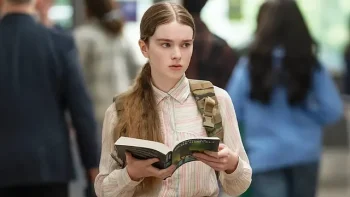
Like its predecessors, Flanagan’s Carrie features a main character that bears little physical resemblance to the overweight, pimply teenager of King’s book, but given that film and television are visual mediums that’s probably unlikely to ever happen. Summer H. Howell, who plays Carrie, is lovely, and looks far younger than both the actress’s actual age and the other actors playing her classmates. She brings a sweetness, an innocence limned with kindness, to her performance, which combined with her youthfulness makes the malice directed towards her seem even more base. It’s like watching someone stomp on a kitten. When the kitten inevitably strikes back, the viewer both roots for her and also mourns the loss of her open-heartedness naivety. Howell is fantastic as both the sunny innocent and the retaliating teen coming into her telekinetic powers. Watching how she makes the iconic role her own is fascinating.
The character of her mother Margaret White has been reimagined too. Margaret is still enough of a religious fanatic to refuse to ring up a customer’s vibrator at her new cashiering job, but here her paranoia is driven less by visions of hell and damnation but rather a toxic brew of ultra- conservative religious tropes and deep-state conspiracy theories. Although she struggles to adapt to most basic workplace customs, such as not alienating customers, she easily adapts to social media, launching her own successful account to win fans over to a fight for her brand of parental rights, railing against government and school regulations except when they suit her own purposes. Samanth Sloyan is excellent in the tricky role; she’s able to be stridently dislikable, but unlike Piper Laurie’s famous interpretation of the same character, you get the feeling that underneath all the control and anger she does genuinely care for her daughter in her own twisted fashion.
While most of the updates pay off significant dividends, one of the biggest ones is more of a mixed bag. In this Carrie, she is not alone in having psychic abilities. There’s a group of similarly gifted women, who refer to their shared power as “the shine.” One of them, a character named Emaline, “takes the wheel” at the legendary prom massacre to assist Carrie. The decision to have Carrie not be solely responsible for all the death and mayhem both lets this gentler rendering of her off the hook a little but also dilutes her agency. Another questionable choice was to intercut the prom and town destruction scenes, which are gorgeously staged and filmed, with a series of interviews with witnesses and survivors. These interviews run throughout the series, but are especially distracting at the end. While King’s book is written in an epistolary style and frequently includes excerpts from scientific journals and Susan Snell’s biography, cutting away from the major defining scenes renders what should be a stunning conclusion somewhat anticlimactic.
But overall Flanagan has crafted a timely and emotionally resonant version of Carrie. Judging from the very positive response by viewers, the appetite for tales of female rage and empowerment have not waned any in the over fifty years since King first wrote about the bullied girl who just wanted to have one nice night. The series heavily hints that there will be more adventures in the future for at least some of the characters, and this is something that fans of Stephen King and especially Carrie will definitely look forward to.


