


Portraits of Andrea Palmer (2018)
by Jedd Birkner –
Filmmakers make films. Film critics make genres. Then slice and splice them into sub-genres and hybrid genres. And mull definitions and argue as to which film belongs in which category. Here we are discussing horror. And, happily, I am not a film critic. I am a cineaste. This may sound pretentious but the label is fitting and accurate. I am here to discuss a film but we must also address the question of genres.
The film in question is “Portraits of Andrea Palmer” (2018). This film is one rough watch. I would not not recommend this to anyone. Not because I didn’t like it. I loved it. It is intense and fascinating, dark and disturbing, aurally inspired (kudos to Vince Roth for sound design) but visually challenging. The issue is, it’s like telling someone about “A Serbian Film,” and then they go out and watch it. Do you want it on your conscience that you are somehow responsible for someone else seeing that film? (We will not address personal agency and free will here, but, instead, moral responsibility.)
The protagonist, the eponymous Andrea “Ande” Palmer (played convincingly and thoroughly by Katrina Zova), is impulsive, a drug abuser, prone to making really poor decisions and, accordingly, desperately in need of dough. The film chronicles her downward spiral into drugs and sex work. There is a lot of abuse. There is blood There are guts. And there is hardcore sex. As such it is an integral part of the story and the storytelling, the plot and the realism, the function and the form. It is not prurient or gratuitous, but it is graphic and raw and disturbing.

The film also has elements of the drug addict genre. Films like “Panic in Needle Park” (1971), “Go Ask Alice” (1973), “Christiane F.” (1981), “Drugstore Cowboy” (1989) and “Basketball Diaries” (1995), to name a few. Though in this film the exacerbating factor is the protagonist’s dependence on sex work not so much drug dependency.
Herein lies the issue of genre. What exactly are we dealing with here? If we are here discussing horror films, does this film even qualify as a horror film? If one does an on-line search, one will find “Portraits of Andrea Palmer” listed as a “horror/drama” and described as “a nightmarish glimpse into a sexual hell.” (Who came up with that tagline?!?) One can also find reviews dismissing it as some form of porn. (I would have to question the taste of someone who would find this film arousing.) It begs the question, “what is horror and why are some so reluctant to include this film in the genre?” (Yes, yes, now again we are talking again about film critics – and enthusiasts – and their need to define and categorize that which cannot always be categorized.)
Horror. As Supreme Court Justice Potter Stewart famously said: “I know it when I see it” (Though, of course, he was not referring to the Horror genre at the time.) The Horror genre is a large umbrella. It ranges from Gothic to ghost to monster movies to psychological horror. One may find one’s self arguing about whether a film is a suspense film or a thriller and should it qualify as horror due to elements of blood or number of the gruesome nature of killings (e.g., the Giallo films of Italy).
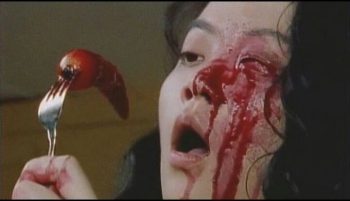
Speaking of blood, that brings us to such sub-genres of horror as the “splatter film” (a term popularized by John McCarty), sub-genre whose roots go back as far as the Grand Guignol theatre in 1890s France and continued through “Psycho” (1960), the Hammer Films entries, the whole zombie sub-genre initiated by George Romero’s “Night of the Living Dead” and Tobe Hooper’s “Texas Chainsaw Massacre.” We also have the “slasher” films which often fall within the splatter film category.
Two other closely related sub-genres are “body horror,” a genre which would include most of David Cronenberg’s works such as “Shivers,” “Scanners,” “The Fly” and “Dead Ringers,” and “torture porn,” a term used by critic David Edelstein in the early 2000s. One thinks of the Saw franchise and the films of Eli Roth such as the Hostel trilogy and “Green Inferno.” Speaking of “Green Inferno,” this was Roth’s homage to the Italian cannibal genre films of the late 1970s/ early 1980s such as Ruggero Deodato’s “Cannibal Holocaust” (1980) and Umberto Lenzi’s “Cannibal Ferox” (1981). Other sub-genres which included torture as a primary element were the Nazispolitation sub-genre and the Nunsploitation sub-genre, both of which also relied heavily on sexual content.
In Asian cinema, the Hong Kong Category III films such as Herman Yau’s “The Untold Story” (1993) and “Ebola Syndrome” (1996) and some of Japan’s “pinku eiga” sexploitation films such as Hisayasu Sato’s “Lolita: Vibrator Torture” (1987) – which in spite of the title is about a serial killer and his disciple – and “Splatter: Naked Blood” (1997) (which includes a you-have-to-see-to-believe scene of a character deep-frying and eating her own fingers) as well as Singapore’s tasty 2014 entry “Lang Tong” are all examples of body horror and/or torture porn.
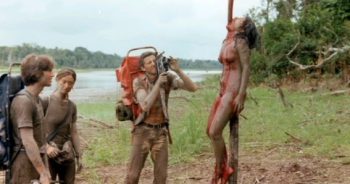
The category “New French Extremity”category is another example of splatter film, body horror and torture porn with such films as Pascal Laugier’s Martyrs (2008) and Julien Maury’s and Alexandre Bustillo’s “ Inside” (2007).
“Portraits of Andrea Palmer” is definitely not a traditional horror film. It is one of feminist, sociological and psychological horror. Watching someone get themself into worse and worse situations. Watching someone slowly get erased. Get used, abused and ultimately turned into an object. It is a horror of the soul.
This is reminiscent of many a downer drug addict pic (e.g., “Christiane F”). It also invokes the cinematic portrayal of sex workers in the extremely downbeat Hong Kong flick “Human Pork Chop.” Being part of the Capitalist economy often requires the worker to give up some part of their autonomy, even their humanity, in return for a paycheck. There are decisions not to help someone in need (not my job), to treat others as less than human (rules are rules), to accept indignities (can’t afford to lose this job!). For many sex workers what is at stake is their very bodies, their sense of self and self-worth. Are they in the end willing to be treated as a piece of meat and how do they deal with the bargains they make with themselves to get through the day? And how they deal with the toll it takes on their soul.
As mentioned above, the film has hardcore sex. If that is a non-starter for the viewer, be warned. It is brutal and transgressive. There are some scenes which are not faked and in which the pain is real. It is not pretty to look at. In any sense. The cinematography itself is as dark and muddy as the moral milieu. Some scenes one can barely make out. If not for the cinema verite feel it could be a Richard Kern joint. But its lack of slickness is also its strength. It feels disturbingly real. The suspension of disbelief is real and total. We really feel we are watching the degradation and unraveling of this woman. And, while she has no one to blame for her decisions but herself, nevertheless the predatory males in this film who took advantage of her weakness and pushed her to the edge deserve a special place in hell..
Do not go into this film lightly, my friends. You may regret it.
Jedd Birkner – A Classics scholar, Ivy League wrestler and former A.F.I. screenwriting fellow, Jedd spent over forty years in the entertainment industry including a thirty year stint at 20th Century Fox. Now, when he’s not summiting peaks or doing photography, he does what he does best: watch a shitload of films. His preferred watches are dark, transgressive and often don’t have subtitles…but should (his knowledge of Japanese and Mandarin are very limited).


