UNDERTONE : UNDERCOOKED (AND UNDER-HEARD!) A24 HORROR
Review By
Tom Lavagnino
It’s 2026. To craft a memorable horror film, the traditional school of thought is : Make it scary.
A more contemporary one is : Come up with a gimmick.
Over the course of the past year, Steven Soderbergh’s PRESENCE (told from the unwavering POV of a ghost), the slow-burn GOOD BOY (horror filmed entirely from a dog’s perspective) and the Anthony Mackie-starring ELEVATION (which tore a page from A QUIET PLACE, presenting its blood-curdling monsters as “neutralized not by noise, but instead by reaching a certain altitude”) have employed unique storytelling-rules-and-filming-parameters as a means of re-jiggering the horror tropes we’ve all grown so familiar with.
Add to the canon UNDERTONE, the latest A24, set entirely within the confines of a house (the living room / bedroom / bathroom are all we see) — with scares conveyed, through the bulk of its running time, almost exclusively through audio.
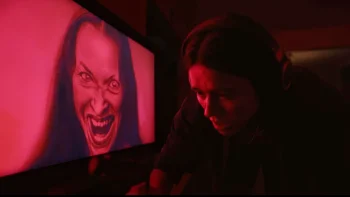
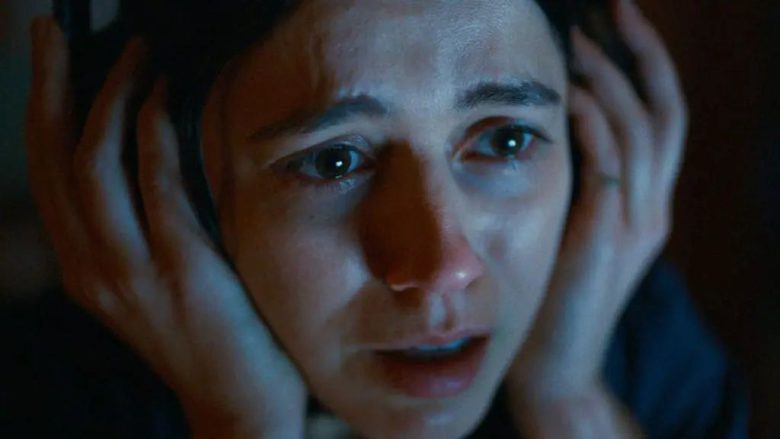
The house in question is the domicile of troubled Evy (the excellent actress Nina Kiri), who’s the remote-based co-host, with Justin (Adam DiMarco), of a paranormal-centric podcast set up in her living room. The only other person we see, throughout the entirety of the story, is Evy’s comatose mother-in-her-bedroom-upstairs; tending to her mother’s needs, the responsibilities associated with the podcast, and a surprise pregnancy all combine to fuel the tension, drama, and burgeoning terror of Evy’s existence.
It’s a set-up that prompts a singular dramaturgical exercise : Make Evy’s (and, by extension, the audience’s) emotional connection to an anonymous e-mail-with-audio-attachments, sent randomly to Justin and aired (with escalating horror-induced intensity) on the podcast, something that will engage, resonate, chill the soul, and result in a satisfying viewing experience.
Here’s the problem : It doesn’t. Among the film’s credibility-crushing issues is the fact that both Evy and Justin come off as utterly naïve; the two characters are presented as long-time stewards of their “all things creepy” podcast — but if we, as an audience, perceive the “scary audio files” as bullshit fakery (and believe me, we do), it’s problematic that they don’t also.
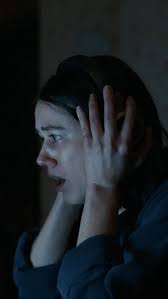
More pointedly, the movie takes a slovenly approach to its “listen and be scared” dynamic, failing to invest the narrative with enough invention, listening-wise, to truly surprise; other, vaguely similar movies (the radio DJ pics PONTYPOOL and period film THE VAST OF NIGHT) did a much more successful job of it, frankly.
Thusly painted into a corner by its audio conceit, and devoid of original, creative ideas to expand the possibilities of its premise, UNDERTONE is forced to jettison the challenge of fabricating horror exclusively through sound, and so it resorts — as the final reel’s obligatory climax comes into view — to the usual pyrotechnical smorgasbord of dutch angles, music stings, and jump-scare editing to underscore its protagonist’s “psychologically devastating” end-point.
UNDERTONE is a missed opportunity, for sure. The prospect of a horror-centric story based wholly on sound (Coppola’s THE CONVERSATION with frights in lieu of conspiracies, anyone?) is a fruitful one, and the recent Apple TV series CALLS, created by Fede Alvarez (writer/director of DON’T BREATHE) is, in a very literal sense, radio drama (as the thriller-based story proceeds, one’s TV screen showcases a spiking VU meter — and nothing else).